




What It Means for OB/GYN and Residency Programs
In a bold move that’s turning heads across the medical world, the American College of Obstetricians and Gynecologists (ACOG) has officially cut ties with U.S. federal government funding.
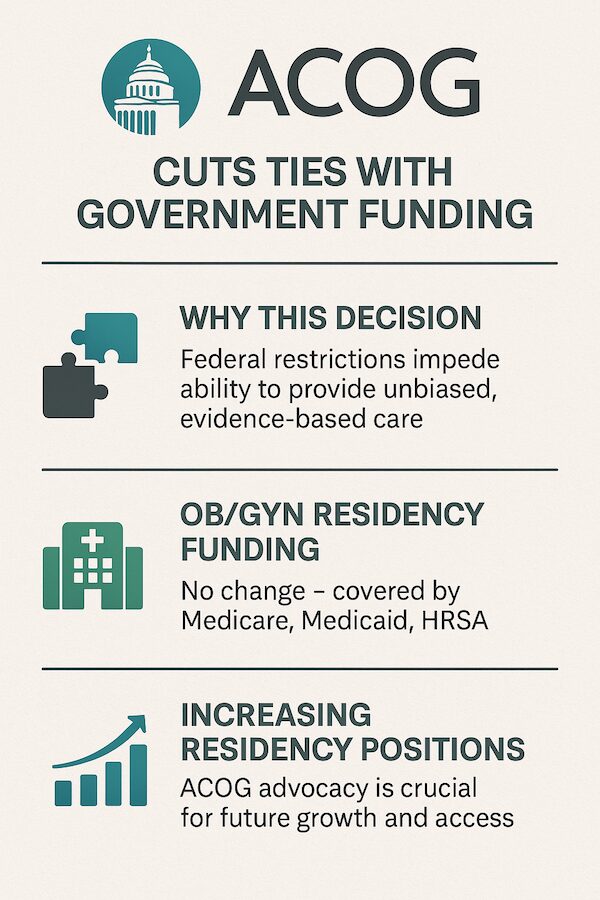
On August 1, 2025, ACOG announced that it would no longer accept federal dollars, a first in the organization’s history. Why? They say recent federal restrictions are interfering with their ability to give timely, evidence-based medical advice for women’s health.
“We cannot do our job for America’s women when political interference restricts our voice,” said ACOG leadership in a public statement.
Let’s break down what this means and what’s not changing, especially for OB/GYN doctors, trainees, and the future of residency funding.
🧩 Why Did ACOG Reject Federal Funds?
ACOG, which represents over 60,000 OB/GYNs and trainees, has long partnered with the government to shape health guidelines, especially around preventive care for women.
But lately, under restrictive federal policies, ACOG says it can’t fulfill its mission freely. So they walked away.
Here’s what prompted the decision:
- Political interference in clinical guidance
- Limits on ACOG’s ability to produce unbiased recommendations
- A shift toward independence and transparency
ACOG had received nearly $950,000 in 2025 from the U.S. Department of Health and Human Services. That support is now gone, but their commitment to advocacy? Stronger than ever.
❓What About OB/GYN Residency Funding?
Good news: Residency programs are not directly affected by this decision.
Let’s clear up a common confusion. Residency programs are accredited by the ACGME (Accreditation Council for Graduate Medical Education), but funded mostly by Medicare and Medicaid, not ACOG.
Here’s how funding works:
Source of Residency Funding | Role |
| Medicare (Federal) | Pays teaching hospitals for resident salaries (DGME) and overhead (IME) |
| Medicaid (State/Federal) | Some states offer additional GME support |
| HRSA Grants | Health Resources and Services Administration) Target underserved and rural residency programs |
| Teaching Hospitals | Cover costs beyond federal cap |
So ACOG leaving the federal funding pool doesn’t cut off the pipelines for OB/GYN residency slots. However, ACOG has been a key player in fighting for more of these slots and that part will rely on their ability to self-fund and lobby effectively.
📈 What Does the Future Look Like?
✅ What Stays the Same:
- Hospitals will continue to receive Medicare and Medicaid funds for OB/GYN residencies.
- The ACGME will still accredit programs without change.
- HRSA’s Teaching Health Center programs will still operate.
⚠️ What Might Change:
- ACOG’s ability to expand residency opportunities, especially in underserved areas, could be limited by budget.
- Advocacy for increased GME slots (such as ACOG’s push for 14,000 new slots) will depend on fundraising and political traction, not federal grants.
💡 Why This Matters
OB/GYN residencies are under enormous pressure. The U.S. faces:
- A shortage of OB/GYNs, especially in rural areas
- A maternal mortality crisis
- A growing number of residency applicants, but limited slots
ACOG has been one of the few organizations fighting hard to change this. By stepping away from federal dollars, ACOG is betting it can protect its independence and integrity, but that comes with financial risk.
Bottom line: OB/GYN residency funding is safe for now, but continued growth depends on political will—and ACOG’s ability to self-sustain its advocacy machine.
📊 How Many First-Year (PGY 1) OB/GYN Spots Are There?
Here’s where it gets critical:
- In the 2025 Main Residency Match, a record 40,041 total PGY‑1 positions were offered across all specialties, up from previous years.
- Specifically for OB/GYN, 1,604 PGY‑1 positions were offered in 2025, with only 10 unfilled.
That means demand continues to outperform supply for a specialty critical to women’s health, maternal care, and reproductive justice.
🛠️ Why Increasing OB/GYN Residency Slots via ACOG Advocacy Is Essential
High Demand, Limited Supply
With nearly every OB/GYN residency slot filled, there’s no surplus, just growing competition and unmet need.
Addressing Workforce Shortages
Many areas, especially rural and underserved, face severe OB/GYN shortages. More residency slots mean more trained physicians in areas that need them most.
Reducing Maternal Health Disparities
Expanding training helps ACOG meet goals around equity, workforce diversity, and lowering maternal mortality rates, especially among marginalized communities.
ACOG Advocacy Matters
While ACOG no longer directly accepts federal funding, it continues to play a vital role in lobbying for policies that increase Medicare-supported graduate medical education (GME) slots and HRSA grants.
🔍 Quick Takeaways
- ACOG is no longer accepting federal funding due to political restrictions.
- Residency programs remain funded through Medicare/Medicaid—no immediate change.
- ACOG’s advocacy for new residency slots and women’s health policy will continue, now independently.
- This shift underscores a growing divide between science-driven medical groups and politicized federal policy.
🎯 What Can You Do?
If you’re a:
- Resident or applicant → No change to your funding, but watch for updates on expansion efforts.
- Educator or hospital administrator → Stay informed on GME policy and HRSA grant opportunities.
- Supporter of women’s health → Consider donating to ACOG or reaching out to legislators about the importance of OB/GYN residency funding.
📌 ACOG’s exit from federal funding is more than a political statement—it’s a pivot point for the future of OB/GYN care in the U.S. As maternal care becomes more politicized, the medical community is choosing independence to protect science, advocacy, and, ultimately, patients.
Stay tuned.
Miya V.